
More than two hundred Black musicians who attended the 1972 biennial convention of the Music Educators National Conference (MENC) in Atlanta, GA convened an impromptu, offsite protest meeting in direct response to the dearth of Black music and Black musicians represented on the program and the near exclusion of Black musicians on the Jazz Night program. The unprecedented and impactful meeting was held on the campus of Morehouse College on the last day of the five-day convention, March 11, 1972. It was chaired by T. J. Anderson, who was elected the first National Chairman (later President); Eddie Meadows was elected Vice President and Warrick Carter was elected Treasurer and became the Executive Secretary. This initial meeting, while in protest of MENC’s practice of marginalizing Black presence with its convention programming, nevertheless, generated an excitement, passion, and fervor to establish an organization that would ensure the inclusion of Black clinicians and conductors, Black performance groups, and the music of African Americans at national and regional conventions of MENC. This historic meeting inspired all in attendance and laid the groundwork for a new and bold organization whose primary mission was to promote, preserve and advance the tradition of African American music and to serve as a voice for the concerns and interests of African American music educators. The name of the new organization became the National Black Music Caucus (NBMC). After 25 years, the name was changed to the National Association for the Study and Performance of African American Music (NASPAAM) but the mission remained the same.
As the membership, infrastructure, and strength of NBMC and NASPAAM grew, the organization began a practice of sponsoring its own biennial national conferences that not only expanded the footprint of the organization significantly but increased its influence and impact. With the decision by the Board of Directors to sponsor NBMC conferences, NBMC shed its dependency on MENC to present more Black performers, presenters and clinicians, more provocative topics about the tradition of African American music, indeed more Black music. The NBMC conference became the primary vehicle to deliver the music of Black America and the African Diaspora. More importantly, the conference became the best and most effective way for NBMC to realize its mission and goals to promote, preserve and advance the tradition of African American music.
NBMC and NASPAAM National Professional Conferences were held in Atlanta GA, Charlotte NC, Nashville TN, Philadelphia PA, Washington DC, Birmingham AL, Chicago IL, Jackson MS, and Houston TX. The national conferences brought together leading scholars, conductors, composers, performers, clinicians, researchers, music educators and ensembles representing the rich tradition of African American music. The NBMC Symposia were held in Bloomington IN and Chesapeake VA. Two NASPAAM Think Tanks were held in Philadelphia and Atlanta. Additionally, the organization published a newsletter, Con Brio, and a journal, Talking Drum.
The NBMC/NASPAAM story is an inspiring one defined by purpose, tenacity, and triumph. It is a narrative of committed, dedicated officers and board members who worked tirelessly toward a singular mission that they themselves defined—to promote, preserve, and advance the rich tradition and legacy of African American music throughout the world through education. The accomplishments are even more remarkable when one realizes that NBMC/NASPAAM, in addition to the conferences, think tanks, and symposia, also provided professional development opportunities for music educators and music students across the nation, with no staff, no office space, a volunteer board of directors, and non-salaried officers, or in the words of former President Carlesta Henderson, “no money, no thought of personal gain, but only a mission…”
Read more in “The Radical Origins and Mission of the National Black Music Caucus: The First Twenty-Five Years—1972–1997” by Loneka Wilkinson Battiste, William T. McDaniel and Rosita M. Sands, as published in the Journal of Historical Research in Music Education (March 7, 2022)
NAfME Resolution to NASPAAM
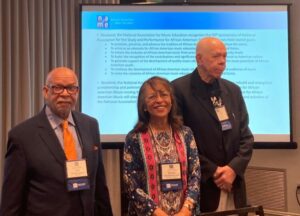
From left. NASPAAM past president and co-founder Dr. Ted McDaniel, NASPAAM president Dr. Marsha Kindall-Smith, and NASPAAM past president Dr. George E. Allen are recognized by the NAfME National Assembly on June 22, 2022. Photo by E. Lasko.
On June 22, 2022, NAfME president Scott R. Sheehan announced at the 2022 National Leadership Assembly in Reston, VA, that NAfME would formally recognize the 50th anniversary of the National Association for the Study and Performance of African American Music (NASPAAM) with a resolution celebrating the milestone. Present at the announcement were NASPAAM president Marsha Kindall-Smith, past president and co-founder Ted McDaniel, and past president George E. Allen, along with the NAfME National Executive Board, the chairs of the NAfME Societies and Councils, and the presidents of the NAfME federated state music education associations.
“We had the privilege to honor the leaders from NASPAAM as they celebrated their 50th anniversary,” said Sheehan. “The celebration felt just as profound as it was historic during the 2022 NAfME National Leadership Assembly. In many ways it was like a homecoming of sorts, but we also recognize the role that the harmful actions of NAfME, then MENC, had in the founding of NASPAAM five decades ago. Although we are just beginning to forge a new relationship, the leaders of NAfME and NASPAAM are confident we will find ways to support one another, and NASPAAM will always have a place to belong at NAfME. I look forward to what the future holds for both of our associations.”